Two Days, One War: Why the end of the greatest conflict in history is commemorated not only on May 8, but also on May 9
Every May, Europe commemorates the end of the most terrible war in human history. At first glance, the simple question—when exactly did World War II end?—hides a surprisingly complicated answer that has to do with time zones, Stalin’s vanity, the Cold War, and even the fact that the war actually ended on a completely different day than most of us think.
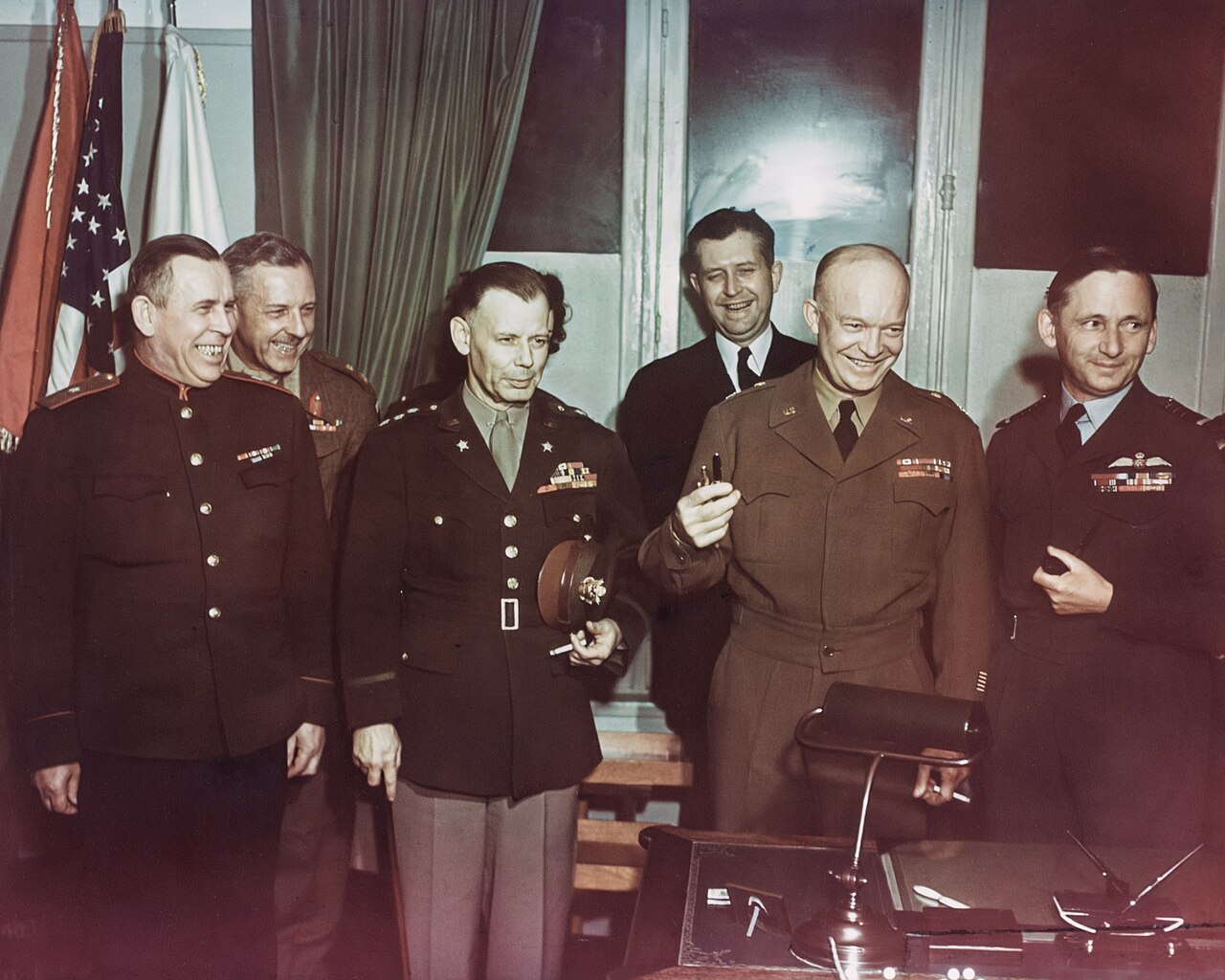
The Surrender in Reims: The First Signature
The story of the end of the war in Europe began to unfold in the early morning hours of May 7, 1945, in the French city of Reims. The signing of the unconditional surrender of the German armed forces took place in the headquarters of the Supreme Commander of the Allied Forces, General and future U.S. President Dwight D. Eisenhower. [1] On the German side, the document was signed by Colonel General Alfred Jodl on the orders of Admiral Karl Dönitz, who was Hitler’s successor. [3]
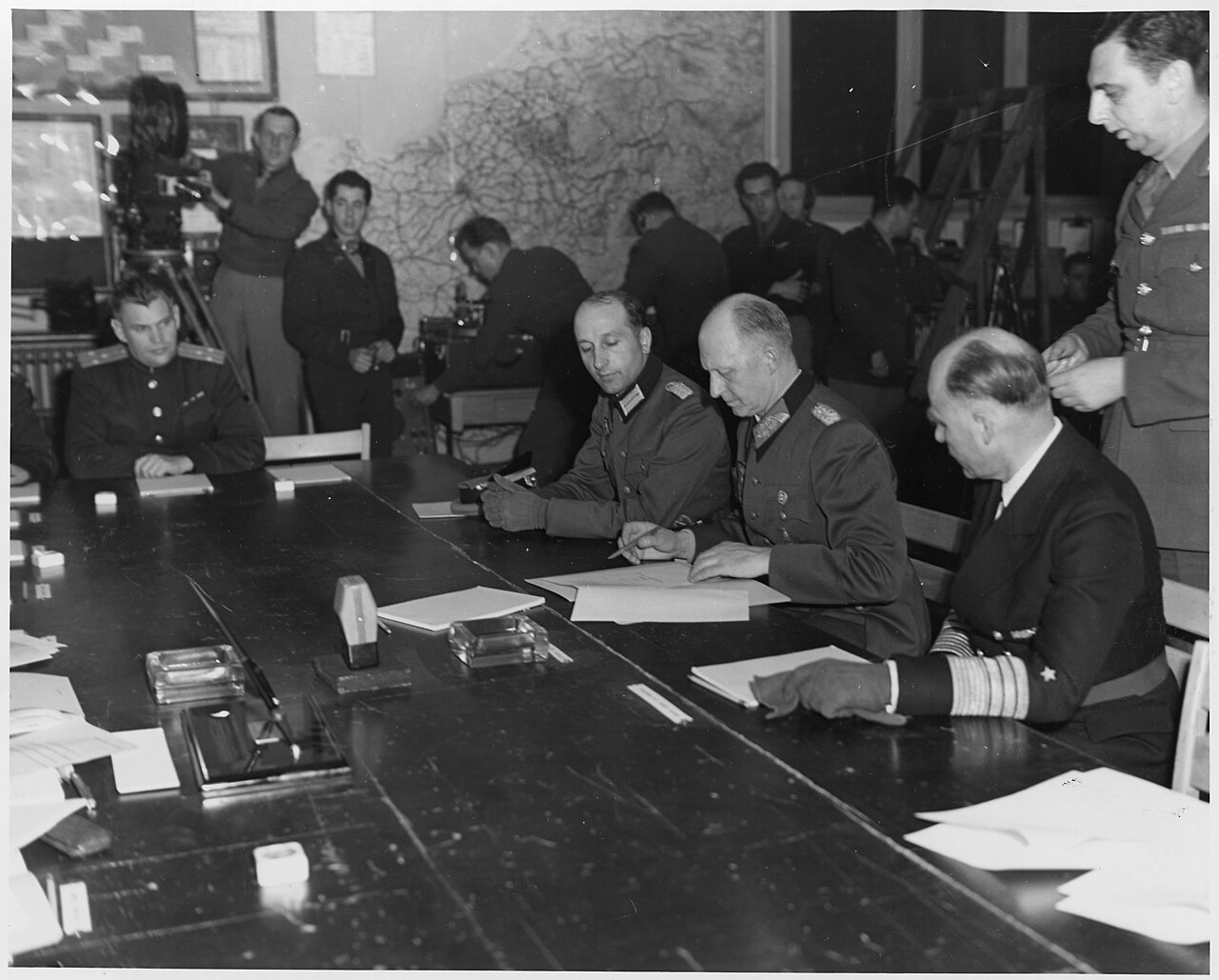
Representatives of the German armed forces pledged to cease all combat operations at 11:01 p.m. the following day, May 8. [1] It would seem that the matter was clear—the war was over, the generals had shaken hands, and the soldiers could lay down their arms. However, Stalin did not envision it being that simple. [1]
Stalin’s Dissatisfaction: Why There Were Two Surrenders
The Soviet Union was dissatisfied that the act of surrender had been signed without its significant participation and not in Berlin, where the decisive battle had taken place. [1] When Soviet leader Stalin learned of the signing of the surrender in Reims, he referred to it as a “preliminary protocol on Germany’s surrender.” [7]
He viewed the signing of the surrender in this city in northeastern France as a diminishment of the Soviet Union’s role in World War II, given that 73 percent of German soldiers had perished and 75 percent of Nazi military equipment had been destroyed on the Soviet-German front. [7] However, Stalin’s displeasure was primarily caused by the fact that the surrender did not take place in the heart of the Third Reich, namely in Berlin. [7]
Joseph Stalin therefore insisted that the surrender be repeated—this time at the headquarters of the Soviet command in the Berlin district of Karlshorst. [1] The surrender, which had already been agreed upon on May 7, 1945, in Reims, was formally confirmed the following day directly in Berlin at the request of the Soviet side—which had not been adequately represented at the initial signing—in the presence of representatives of all Allied forces and with proper ceremonial trappings suitable for historical photographic documentation. [1]
Berlin-Karlshorst: The Second Signing and the Birth of Two Dates
Thus, on the evening of May 8, representatives of the Allies met again at the Soviet headquarters in Berlin-Karlshorst. [1] The USSR was represented by none other than Georgy Zhukov, Marshal of the Soviet Union, a living legend and the architect of the greatest victories over Germany. [1] Field Marshal Wilhelm Keitel, with his signature, consigned the defeated Wehrmacht to history. [1] Both Jodl and Keitel were later convicted in Nuremberg and hanged on October 16, 1946, along with eight others.
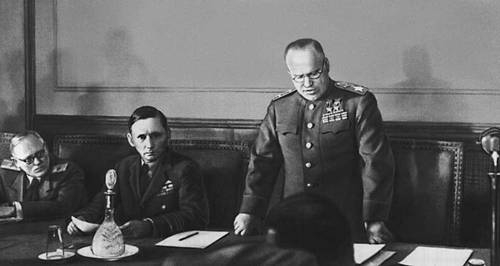
This symbolically confirmed the capture of Berlin as the capital of the Third Reich and the epicenter of an aggressive ideology that deprived millions of people of their freedom, health, and lives. [1]
The Magic of Time Zones
The document took effect on May 8, 1945, at 11:01 p.m. Central European Time, which was already past midnight on May 9 according to Moscow time. [1] But in London, it was just striking ten in the evening; in America, it was still only the afternoon; and in Moscow, by contrast, it was already May 9, one hour past midnight. [1]
This “calendar technicality” later took on a political character, as the “Moscow” dating of the event became established in countries under Soviet influence, regardless of their time zones. [1] The Soviet Union therefore always celebrated Victory Day on May 9, as did other Eastern Bloc countries, including Czechoslovakia. [1]
Two worlds, two holidays
European countries commemorate the end of World War II on May 8 as Victory Day over Fascism. In English-speaking countries, it is also known as Victory in Europe Day. [7] In Russia and some other countries of the former Soviet Union, the defeat of Nazi Germany is still commemorated a day later—on May 9—as Victory Day in the Great Patriotic War. [7]
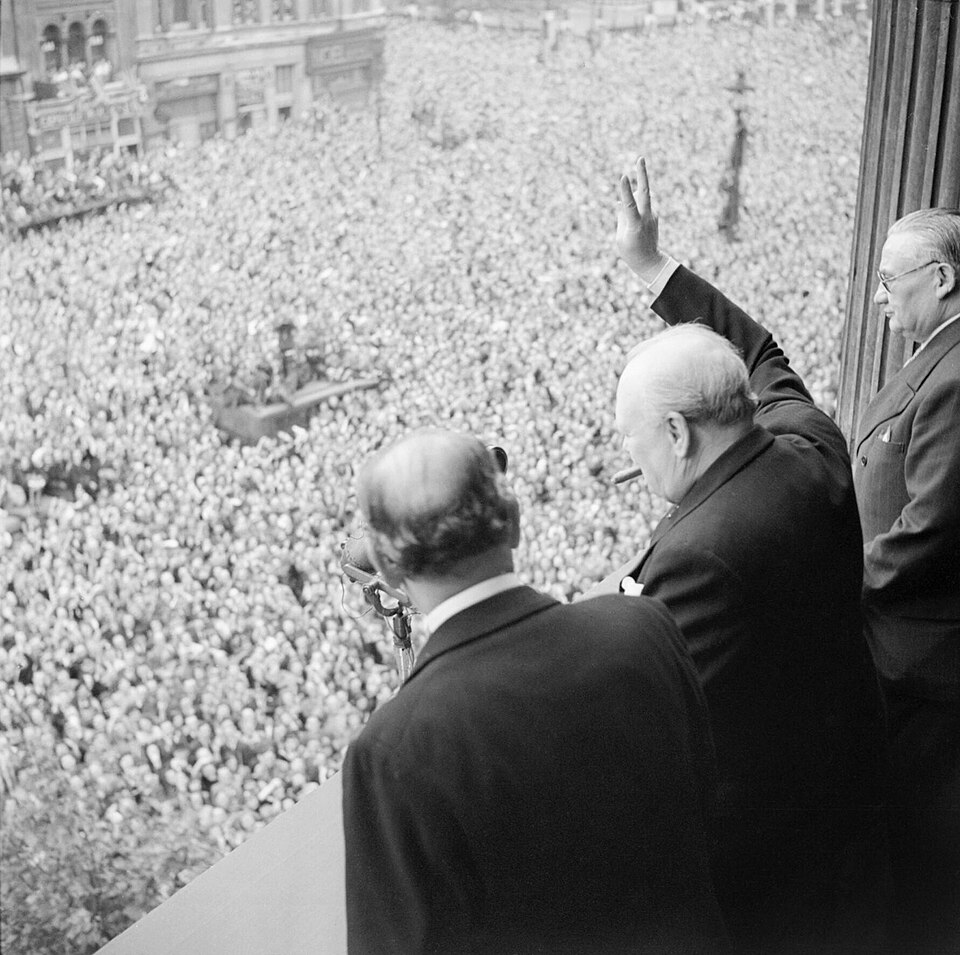
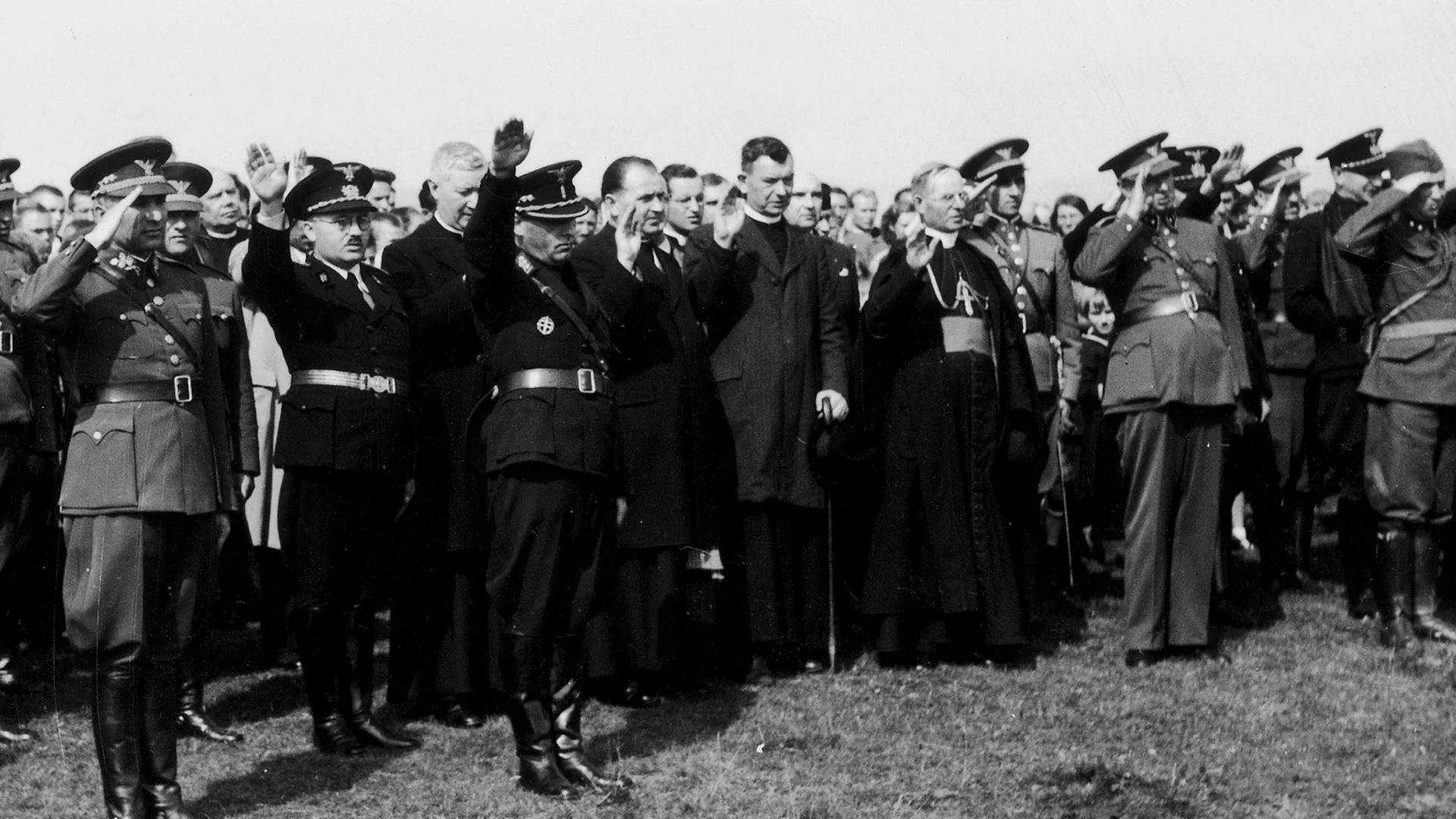
The anniversary of the end of World War II in Europe is currently celebrated in Slovakia on May 8; in the past, it was celebrated on May 9. [7] In Czechoslovakia, and thus also in Slovakia, May 9 was celebrated as the Day of the Liberation of Czechoslovakia by the Red Army until 1990. [7] At that time, the name of the holiday was changed to Victory Day over Fascism, and a year later, the date of the celebration itself was changed; the Soviet tradition was abandoned, and Victory Day over Fascism was moved to May 8. [7]
In Resolution 59/26 of November 22, 2004, the UN General Assembly declared May 8 and 9 as Days of Remembrance and Reconciliation in honor of all those who died during World War II. [7] The UN called on its member states, non-governmental organizations, and individuals to commemorate these days in May each year—one or the other, or both. [7]
In Banská Bystrica, they knew even earlier
In Banská Bystrica, however, the end of the terrible war was celebrated a day earlier, on May 7, 1945. The city was liberated on March 25, 1945, by Romanian and Soviet soldiers, and since then, its residents had been eagerly awaiting news of the war’s final end. [3] On May 7, young newspaper boys sold the local paper Vatra in the main square, shouting the headlines to the world: “Germany has fallen! Germany has surrendered!” [3]
It later turned out that London Radio had rushed the news of the war’s end, which Vatra had also picked up. [3] The revived daily Pravda did not report this news until May 8, while also reporting on street fighting in Prague. [3]
When the War Refused to End: The Last Shots in Europe
The signing of the unconditional surrender of all German armed forces on May 8, 1945, did not yet mean the end of the war in Europe. [3] Nevertheless, fighting continued, and the SS in particular put up tenacious resistance. Even after the surrender was signed, Europe remained a chaotic continent; the fighting did not cease, and in many places, armed Germans still held sway. [9]
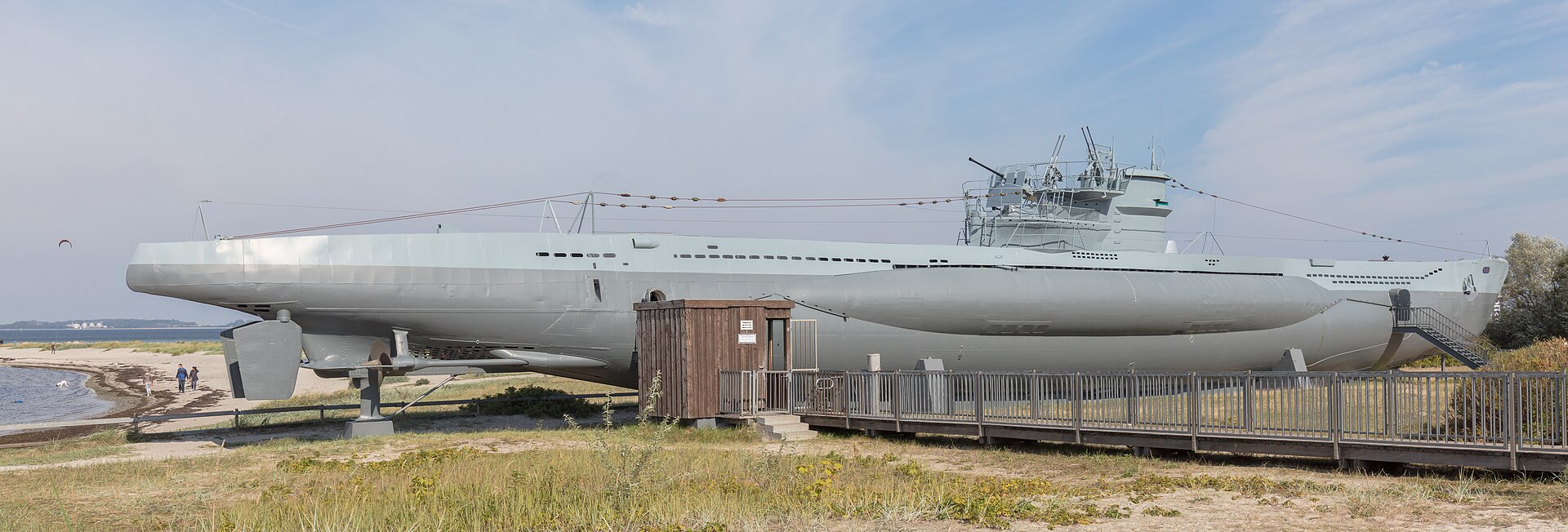
German soldiers remained in several well-fortified ports on the Atlantic coast until the end of the war. La Rochelle, Dunkirk, Lorient, and St. Nazaire did not surrender until May, with the submarine base at St. Nazaire being the last to fall on May 11, four days after the surrender was signed, into the hands of the Western Allies. [9] The Germans also held out on the Channel Islands in the English Channel near the French mainland, where nearly 30,000 soldiers were well fortified. [9]
Prague: The Last Capital in German Hands
The last European capital under German control was Prague, which the Red Army did not enter until the morning of May 9. [3] However, most German soldiers had long since departed by that time (largely due to the Prague Uprising), and disorganized groups of Wehrmacht and SS units were retreating chaotically toward the southwest. [3]
Prague, the capital of Czechoslovakia, was liberated by Red Army units on May 9, 1945, but this did not end the war on its territory. [3] Even after this date, combat operations continued, essentially ending on Czech territory on May 11 or May 14, when a combat group of the German 16th Panzer Division fought its way into the American zone, where they intended to surrender. [7]
The Battle of Slivice: The Last Major Engagement
One of the last battles of World War II in Europe took place in Central Bohemia on May 11–12, 1945. [3], that is, as late as four days after the surrender of the German armed forces. [3]
One of the largest groups of Germans, numbering approximately 7,000 men (members of the SS Wallenstein combat group, the Wehrmacht, and the Gestapo), fought their way on May 10 to the hamlet of Slivice, which is part of the village of Milín near Příbram. [3] The attack began on May 11 with a heavy artillery barrage, including BM-13 rocket launchers “Katyusha” rocket launchers, and the situation for the 7,000 defending Germans was hopeless, so an hour and a half past midnight on the following day, May 12, SS-Gruppenführer Carl Friedrich von Pückler-Burghauss signed the surrender on the outskirts of Čimelice. [3]
The final close-quarters fighting took place in the early morning of May 12—by then, the encircled Germans no longer had the strength to resist and, in a hopeless situation, decided to surrender. [3] In the northern part of Yugoslavia, German troops retreating to Austria were still fighting as late as May 15. [7]
Even Further from the End: Odžak and Other Sites of Resistance
There are still several places in Europe believed to have been the sites of the last battles of World War II. [3] They are found in the Baltic states and in the territory of the former Yugoslavia. [3]
The partisans managed to liberate Sarajevo as early as the beginning of April 1945, but they were not able to successfully conclude the Battle of Odžak until 16 days after Germany’s surrender in the restored Yugoslavia, that is, on May 25. [3] However, it can hardly be called the last battle of World War II, since its second phase was essentially a local partisan war, without the participation of the Allies or the Nazis. [3]
Victory Day in the Soviet Union: From Stalin’s Indifference to Brezhnev’s Parades
Paradoxically, even within the Soviet Union itself, Victory Day did not become established as a public holiday until twenty long years later. [1] While Stalin was building his own cult of a brilliant military leader, he viewed the other surviving veterans more as a potential threat. [1]
Red Army soldiers who had seen the standard of living “in the West” with their own eyes and were shocked by the brick houses and sewer systems in villages were considered a potential source of rebellion and, upon their return, often ended up in the gulags. [1] The same fate, if not outright execution, awaited former prisoners of war who, by having survived in enemy hands at all, earned the label of traitors to the motherland. [1]
Being a relative of a soldier whose place of death was unknown meant that widows and orphans were branded as the family of a deserter—and thus also a traitor to the homeland—which resulted in the loss of entitlement to state support. [1] State authorities also viewed with hostility veterans suffering from severe injuries, whom they claimed to have cared for exemplarily according to their own propaganda—shortly after the war, they were forcibly evicted from cities and herded into mass “homes” with a barracks-style regime. [1]
When the Soviet color epic The Fall of Berlin was completed in 1950 for the fifth anniversary of the victory, viewers discovered that Marshal Zhukov’s character had been completely omitted from the final scenes so that his high popularity would not rival Stalin’s in the role of the main hero. [1]
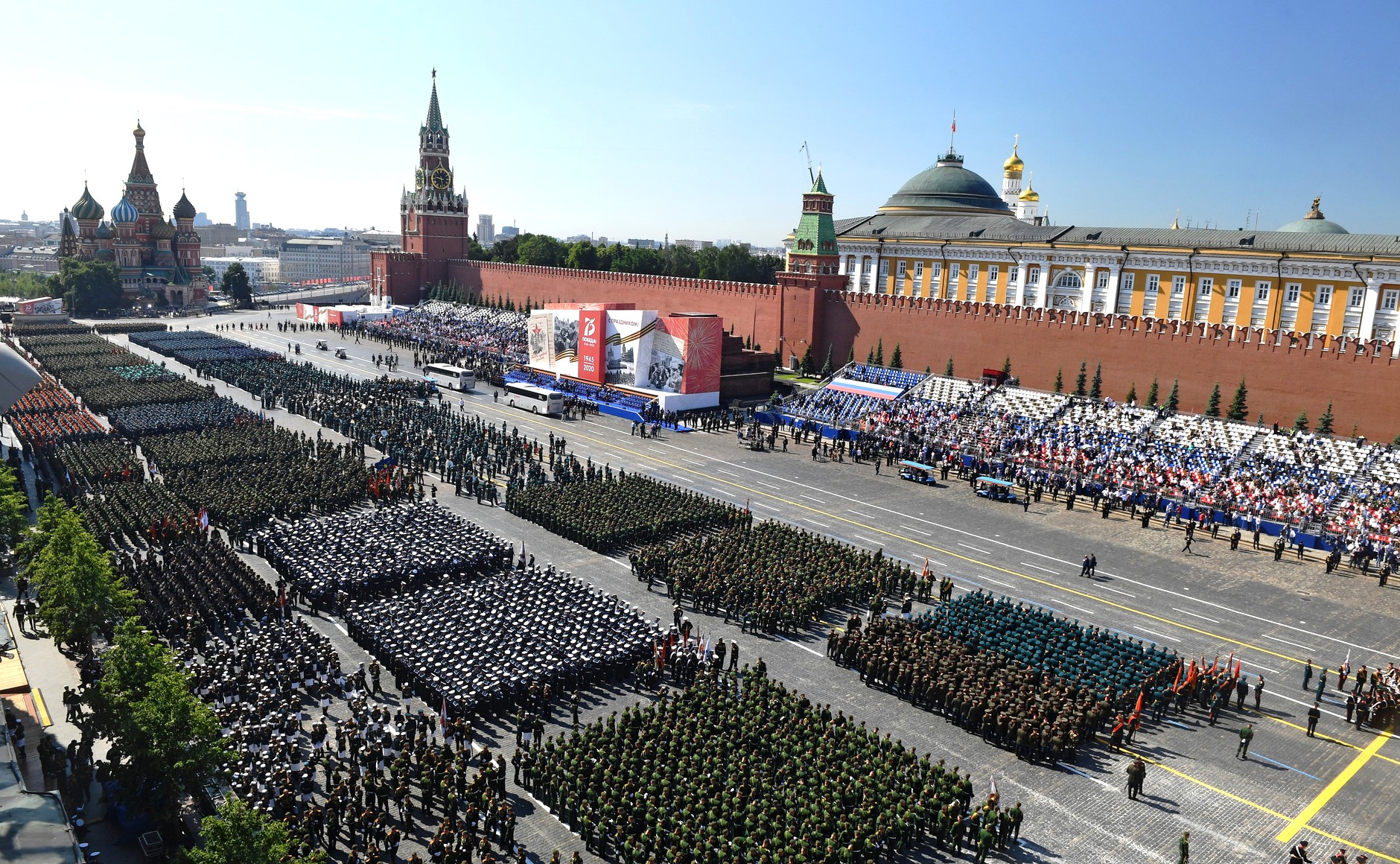
It was not until Leonid Brezhnev, who presented himself as a war veteran, on the occasion of the 20th anniversary celebrations in 1965, established Victory Day as a national holiday, had a monument to the Unknown Soldier with an eternal flame built on Red Square, and introduced annual grand military parades. [1]
These parades became a tradition—in the former USSR, military parades were held on Red Square on Victory Day over Fascism, and Russia revived them in 2008. [7]
The Immortal Regiment and Modern Traditions
Victory Day is considered in Russia to be the holiday that unites the population the most. [5] The war affected every family in the Soviet Union; around 27 million people perished in it. [7] These losses account for 40 percent of all lives lost in World War II, which is why Victory Day in the Great Patriotic War is the holiest holiday for Russians, even as they overlook the fact that they began World War II as Hitler’s allies. [7]
The March of the Immortal Regiment has become a traditional part of the celebrations, during which people carry portraits of their relatives, veterans of World War II. [5] Victory Day is a key anniversary for President Putin, who often recalls the fighting spirit and sacrifices that helped the Soviet Union defeat Nazi Germany in World War II. [5]
The Cold War and the Battle Over Dates
Over time, under the political influence of the Cold War, the memory of the joint victory of all Allied forces over Nazism and the capture of its Berlin stronghold was reduced to a commemoration of the liberation of the state, in which only the Red Army—or rather, the Czechs and Slovaks on the Eastern Front—was remembered. [1] Changes in internal Soviet policy were directly reflected in how the war was commemorated in our country. [1]
In Czechoslovakia, this was emphasized by the fact that the liberation was completed on May 9, 1945, when Soviet troops entered Prague, and the government of the time enforced this through political means and for political reasons.
The actual end: September 2, 1945
However, the entire debate over May 8 or May 9 overlooks one fundamental fact. On May 8, World War II ended only in Europe, and it is often forgotten that it continued fiercely and bloodily in the Pacific and the Far East. [8]
It was not until the dropping of two atomic bombs on Hiroshima and Nagasaki on August 6 and 9, 1945, that the surrender of the Japanese Empire was hastened. [7] Subsequently, in a radio address on August 14, 1945, Emperor Hirohito of Japan called for surrender, describing the end of the war as “the only way to restore peace and save the nation from a terrible fate.” [7]
Thus, on September 2, 1945, the Japanese surrender was signed aboard the American battleship USS Missouri in Tokyo Bay, marking the definitive end of World War II. [7] The Japanese delegation, led by Foreign Minister Mamoru Shigemitsu, signed the surrender document in the presence of General Douglas MacArthur and other Allied representatives. [2]
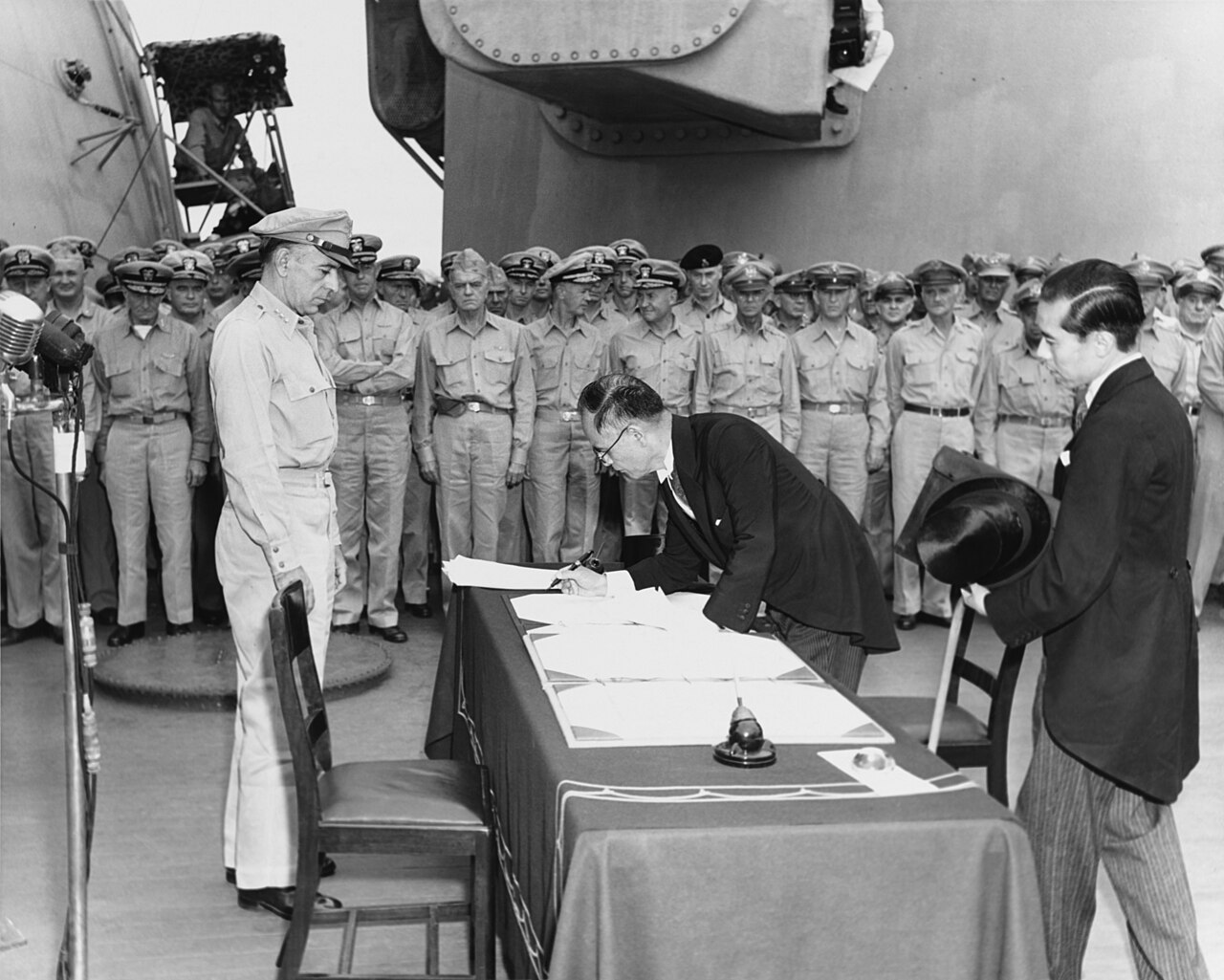
Admiral Chester W. Nimitz signed on behalf of the United States, and as the twenty-minute ceremony concluded, the sun broke through the low clouds. [6] The most devastating war in human history was finally behind them.
Three Dates, One Peace
In the United States, the end of World War II is celebrated in September on the anniversary of Japan’s surrender. [4] Americans celebrated this day until the 1970s as Victory over Japan Day. [1]
The end of the war not only brought the long-awaited peace but also led to dramatic changes in global politics—the United States became the dominant superpower, while the Soviet Union expanded its influence in Eastern Europe and the Far East. [2] Instead of multiple great powers, the world was left with two superpowers, whose rivalry would define global politics for nearly half a century.
So, to the question of when World War II ended, there are several correct answers. For most Europeans, it was May 8; for Russians, May 9; and for the entire world, in fact, not until September 2, 1945. In the Slovak Republic, May 8 is a national holiday, although it is no longer (allegedly temporarily) a day off from work. [1] And while the whole world will likely never agree on the exact date, there is one thing on which everyone agrees—something so terrible must never happen again.
List of References
[1] Victory Day over Fascism: Why We Commemorate the End of World War II on Both May 8 and May 9 https://novohradske.sk/den-vitazstva-nad-fasizmom-preco-si-koniec-druhej-svetovej-vojny-pripominame-8-aj-9-maja/
[2] A Year in History: 1945 Timeline https://www.historic-newspapers.com/en-ae/blogs/timelines/a-year-in-history-1945-timeline?srsltid=AfmBOopiktwZM1SCwL0QchOQ6T_AQg5ZqmIkSpdYWT0jhGu6A8t2QPcR
[3] Slovaks also took part in the final battle of World War II - Unknown History - Journal - Pravda https://zurnal.pravda.sk/neznama-historia/clanok/667415-na-poslednej-bitke-druhej-svetovej-vojny-sa-zucastnili-aj-slovaci/
[4] Putin and Merkel commemorated the anniversary of the end of World War II https://www.teraz.sk/zahranicie/putin-i-merkelova-si-pripomenuli-vyro/547563-clanok.html
[5] Russia celebrated Victory Day with a parade. The weather disrupted the air show https://ct24.ceskatelevize.cz/clanek/svet/rusko-oslavilo-den-vitezstvi-prehlidkou-pocasi-prekazilo-leteckou-cast-97754
[6] Surrender https://ussmissouri.org/history/history-2/surrender
[7] World War II ended in Europe 72 years ago https://www.rusyn.sk/pred-72-rokmi-sa-skoncila-druha-svetova-vojna-v-europe/
[8] A historian’s primary role is to ask questions https://www.rusyn.sk/historik-ma-predovsetkym-klast-otazky/
[9] When the war ended, fighting in Europe continued. What did the war look like after the war? https://standard.sk/355284/ked-sa-skoncila-vojna-boje-v-europe-este-pokracovali-ak